Is there a Companies House for the Republic of Ireland?
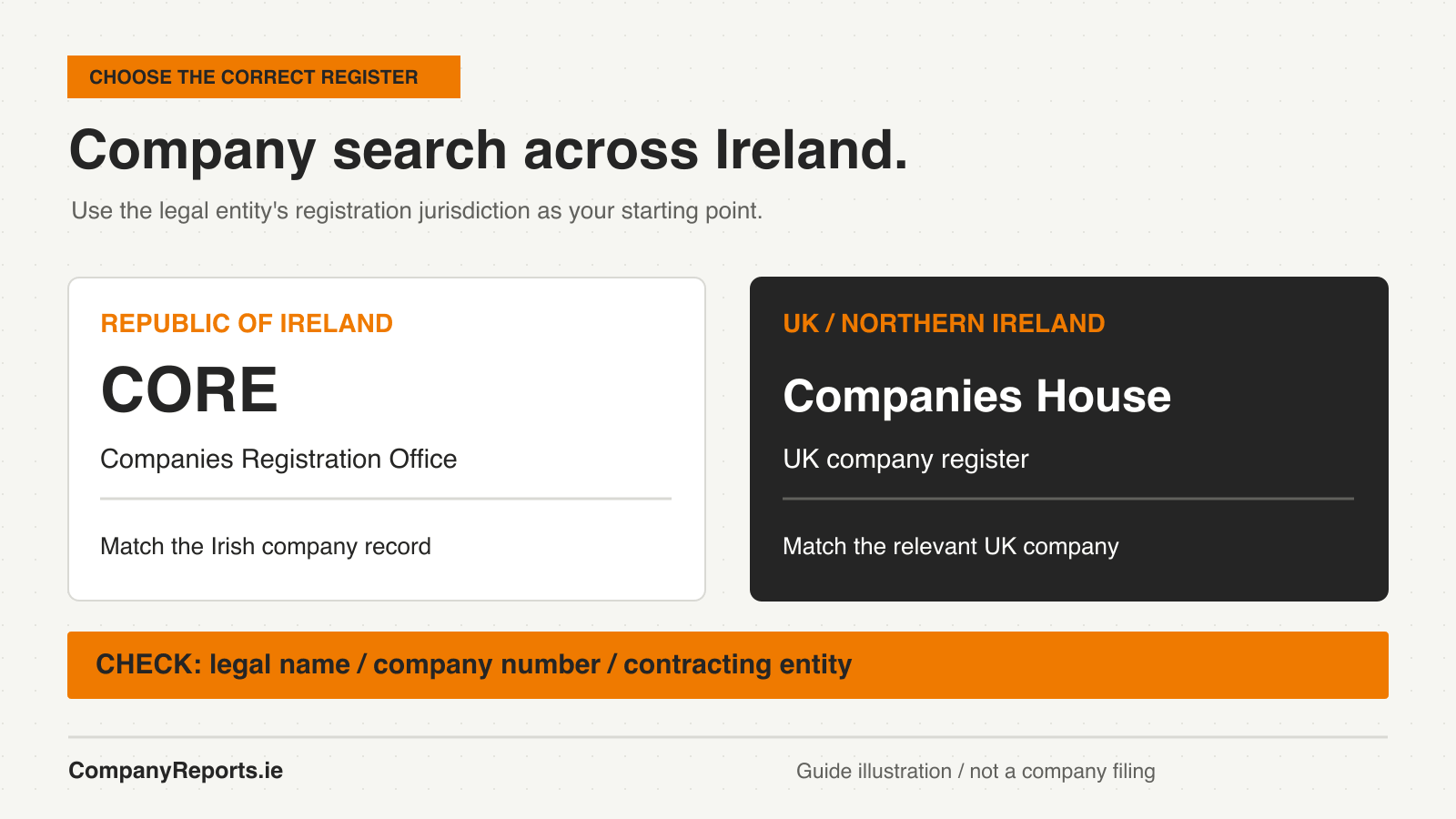
Companies House is the UK registrar. For a Republic of Ireland company, the relevant official entity search is CORE, operated by the Companies Registration Office. The phrase 'Companies House Ireland' is therefore ambiguous: a reader may mean the Irish equivalent of the UK service, or may actually be looking for a Northern Ireland company.
Start by resolving that ambiguity instead of switching between search tools until a familiar brand appears. Check the contract, invoice or company disclosure for the legal name and number. If only a trading name is supplied, ask which person or entity carries the contractual obligation before deciding which corporate record is relevant.
Republic of Ireland and Northern Ireland searches compared
The two official services cover different registration jurisdictions. A Dublin trading address does not by itself establish that the contracting company was incorporated in the Republic of Ireland. Likewise, supplying customers in Belfast does not determine the company's registration. Verify the entity rather than inferring jurisdiction from where it sells.
Keep the register together with the registration number in your notes. Numbers belong to a registration system; a number copied without that context can be ambiguous. For cross-border groups, a separate record for each legal company prevents information about the parent or a similarly named subsidiary being attached to the wrong counterparty.
| Registration | Official search | Starting check |
|---|---|---|
| Republic of Ireland | CORE / Companies Registration Office | Match the Irish legal entity and registration number |
| Northern Ireland | Companies House | Match the UK legal entity and registered jurisdiction |
| Elsewhere in the UK | Companies House | Confirm the relevant company and registration details |
| Group with Irish and UK entities | Both, for the relevant separate entities | Identify which company is actually contracting |
How to search a Republic of Ireland company
Use the registered name or number in CORE and inspect the matching entity. Compare the full legal name and office with the details supplied for your transaction. Where several results have similar names, keep the company number as your anchor and investigate name changes or group relationships separately.
CompanyReports.ie offers an additional route for locating Irish company profiles and reviewing the report options available for an entity. A private directory's search result is not an official endorsement of the business. If the decision depends on an original filing or certificate, establish the exact item required and its official document route.
When examining financial information, keep the company identity attached to the period and document. A public profile and an original accounts file can answer different questions. Record where each item was obtained so a later reviewer can distinguish the directory information from the underlying filing.
How to search a Northern Ireland company
Use the Companies House Find and update company information service. GOV.UK explains that it provides access to company details, filings and officers, with document information available through the service. Search the supplied UK company number or exact registered name and inspect the resulting record.
Confirm the registered jurisdiction and legal identity within the record rather than relying only on a number prefix or postal address. Keep account periods, current status and previous names tied to that entity. If an invoice instead names an Irish sister company, repeat the identity check in CORE for the company actually requesting payment.
CompanyReports.ie focuses on Republic of Ireland company information. The Northern Ireland search route in this guide is the official UK register; do not assume that an Irish directory will contain every UK entity or that its report purchase covers a company registered in another jurisdiction.
Worked example: one brand, two contracting companies
Consider the fictional Northshore Services brand. Its Republic of Ireland quotation names Northshore Services Ireland Limited, while a separate Northern Ireland agreement names Northshore Services NI Limited. The brand is shared, but the names point to potentially different legal obligations. Neither example refers to a real company.
For the Republic of Ireland quotation, verify the identified Irish entity in CORE. For the Northern Ireland agreement, verify the identified UK entity in Companies House. Compare the agreement and payment request with the relevant record. If the payment account or invoice names a third entity, request a documented explanation and verify authority before proceeding.
Group ownership can explain a relationship without merging the companies. Accounts for a parent do not automatically describe an individual subsidiary's finances, and the presence of a group relationship does not itself establish a payment guarantee. Record the contracting entity and any supporting documents on their own terms.
What if no company appears in the results?
First check the jurisdiction, spelling and number. A brand, sole trader, registered business name, partnership or other organisation may not be a company under the name you searched. Ask the counterparty for its legal identity and the basis on which it trades. Searching only limited-company records cannot resolve every form of business.
Next, consider previous names, recent registrations and service availability. Use another verified identifier where possible and compare the result independently. An empty search is a reason to clarify the identity; it is not sufficient evidence to publish a claim that a business is unregistered or fraudulent.
Where the transaction is material, pause until the contracting party can be identified. Keep a dated record of the search and the response from the business. That is more useful than relying on a familiar website name or a screenshot of an unrelated company's registration.
What a register match does and does not establish
A matching record supplies evidence about a registered entity. It does not establish that the person emailing you represents that entity, that the requested bank account belongs to it, or that a commercial promise will be performed. Verify contact details and authority through an independent, trusted channel where the transaction calls for it.
Read financial statements, filings and status in the context of their dates and jurisdiction. UK filing terminology and Irish filing terminology are not interchangeable by default. When legal status, enforcement or ownership is material, use the appropriate current records and professional advice for the relevant jurisdiction.
A useful final note records the register, legal name, company number, review date, contracting role and unresolved questions. For groups operating across the border, keep this information for each entity instead of creating one combined profile under the trading brand.