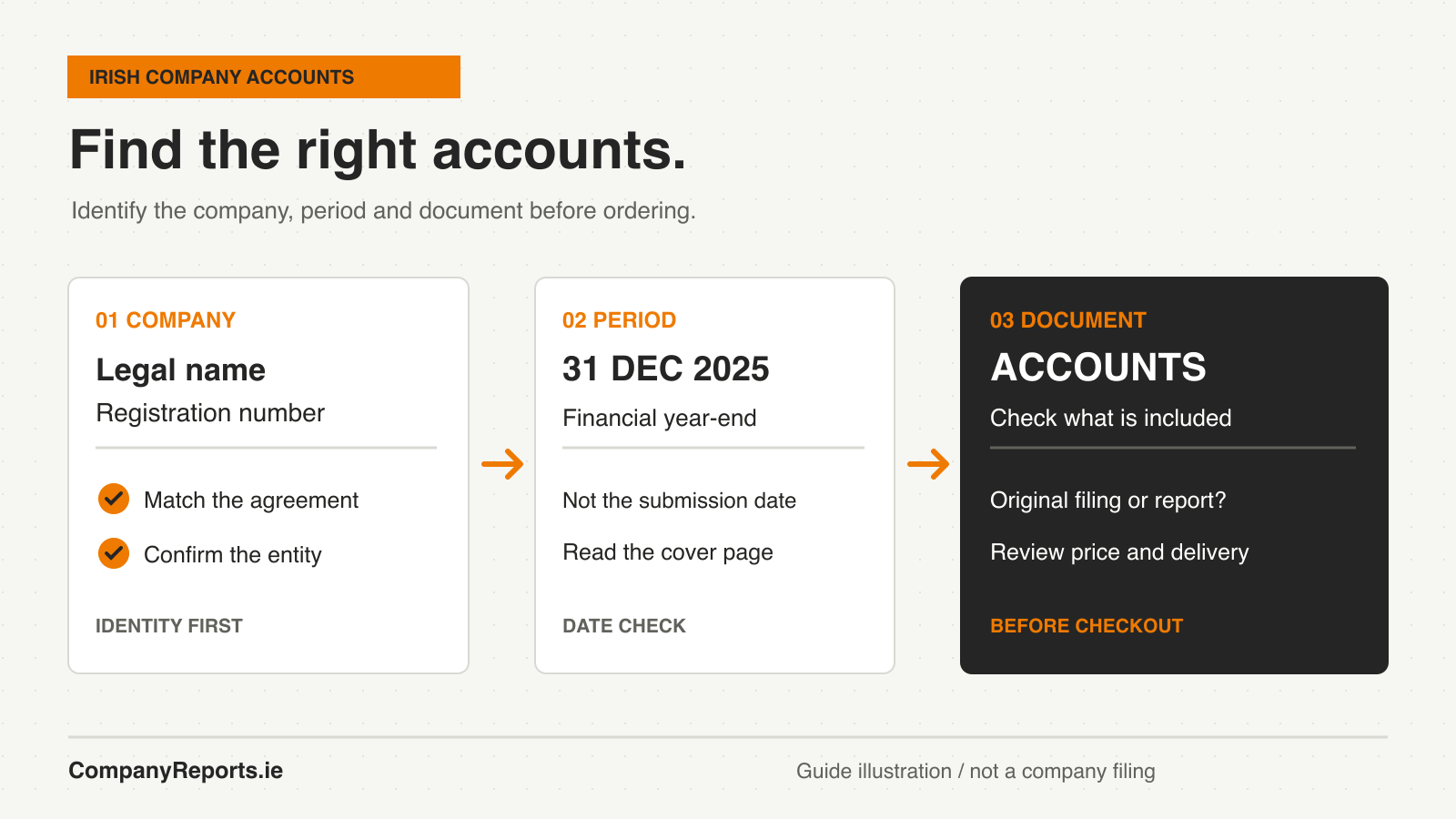
Where can you search Irish company accounts?
The official search service for entities registered in the Republic of Ireland is CORE, operated by the Companies Registration Office. You can search using an entity name or register number. Search the legal company rather than treating a shop name, website domain or group brand as the financial reporting entity.
CompanyReports.ie can help you identify an Irish company and review its public profile. To obtain an original filed financial document through the official route, follow the CORE document search described here. Keep these two tasks connected: a directory search helps locate the entity, while the selected filing supplies the particular accounts you want to read.
Choose the legal entity before you choose a financial year
A group can use one brand while different companies hold property, employ staff, sell services or own intellectual property. Accounts for the parent may therefore answer a different question from accounts for the company sending your invoice. Match the full registered name and number to the agreement and preserve both in your notes.
In a fictional example, a website advertises under Harbour Services, but its contract names Harbour Operations Limited. A similarly named holding company appears in the search results. Buying the holding company's accounts without checking the contract could leave you evaluating a different set of assets and obligations. A matching brand is a starting clue; the company number is the stronger identifier.
If the counterparty cannot identify the contracting entity, resolve that first. More financial detail about the wrong company will not repair an identity mismatch. Where group accounts are relevant, record that they describe a wider reporting boundary than the individual company.
Separate the accounts year from the filing date
A record can be submitted in one calendar year while its accounts describe an earlier financial period. The financial year-end identifies the balance-sheet date and the end of the income-reporting period. The annual-return date belongs to a separate statutory return. The submission date describes when the material was delivered, rather than when the company earned its revenue.
The following dates are invented to illustrate the distinction. If you need the financial position at 31 December 2025, selecting a document solely because it was filed during 2025 may produce the wrong period. Read the document title and then verify the cover page and accounting dates inside the file.
| Date | Example | What it identifies |
|---|---|---|
| Financial year-end | 31 December 2025 | The closing date of the accounting period |
| Annual-return date | 30 September 2026 | The date to which the annual return is made up |
| Submission date | 15 October 2026 | When this example filing was delivered |
| Your review date | 20 November 2026 | When you inspected the available evidence |
What exactly are you buying or downloading?
A company profile, an annual return, a financial-statements file and a compiled company report can contain different information. Before checkout, establish which product is offered and whether it includes the original document for the required period. A report containing a filing list should not be assumed to include every document listed.
CRO guidance confirms that company documents can be searched and purchased through CORE and paid for by card; an account holder can also use a funded account. Consult the current checkout for the applicable charge. This guide deliberately does not copy a document price that could change or imply that all public documents are supplied free.
When ordering through CompanyReports.ie, check the particular report or document description and the stated delivery arrangements. A purchase can involve manual fulfilment. Save the order reference and the year requested so that the delivered item can be checked against your order.
What to check immediately after receiving the accounts
Start with identity and presentation. A figure headed 'EUR thousands' needs a different reading from a figure expressed in individual euros. The current and comparative columns must refer to the periods you expect. An eighteen-month reporting period cannot be compared directly with twelve months without considering that difference.
Next, identify whether the accounts concern the individual company or a consolidated group. Read the accounting policies and exemption statements before deciding what is absent. Use the notes to explain loans, related-party balances, assets and events after the year-end. A scan that appears to contain only a balance sheet may be an abridged public filing rather than an incomplete set supplied by mistake.
- Match the legal name and company number.
- Record the start and end of the financial period.
- Check the currency, units and comparative headings.
- Identify individual or consolidated presentation.
- Read the notes and audit or exemption wording.
- Keep the original file and your separate interpretation.
Why might accounts be missing from the search?
One legitimate explanation is the first annual return after incorporation: CRO guidance states that financial statements are not required with that first return. For other periods, investigate the filing description, reporting regime and available document history. A submission entry, a document that cannot be retrieved and a confirmed absence of a required filing are different findings.
An unavailable listing or temporary service error does not establish that the company failed to file. Search the official record, check a different period, and ask the company for the relevant statements where necessary. If the decision depends on current trading, request current information as well: even the latest publicly filed accounts describe a past period.
Record the limitation in plain language, such as 'accounts for the requested period were not located during this review'. Avoid turning an unsuccessful search into a definite allegation of non-compliance. Equally, do not fill an information gap with an estimated turnover presented as a filed fact.
Build a small evidence file rather than a folder of unexplained PDFs
A useful review record identifies the entity, the document, the period covered, where you obtained it and when you read it. Add a short list of findings and unresolved questions. Keep original statements separate from calculations so another reviewer can reproduce the work without guessing which numbers were copied.
For a supplier decision, connect the accounts to the size of the proposed order, payment terms and your experience of the company. For an acquisition, the public accounts are only one part of a broader review. The right document makes those conversations more specific; it does not replace current evidence or professional interpretation where the commitment warrants it.