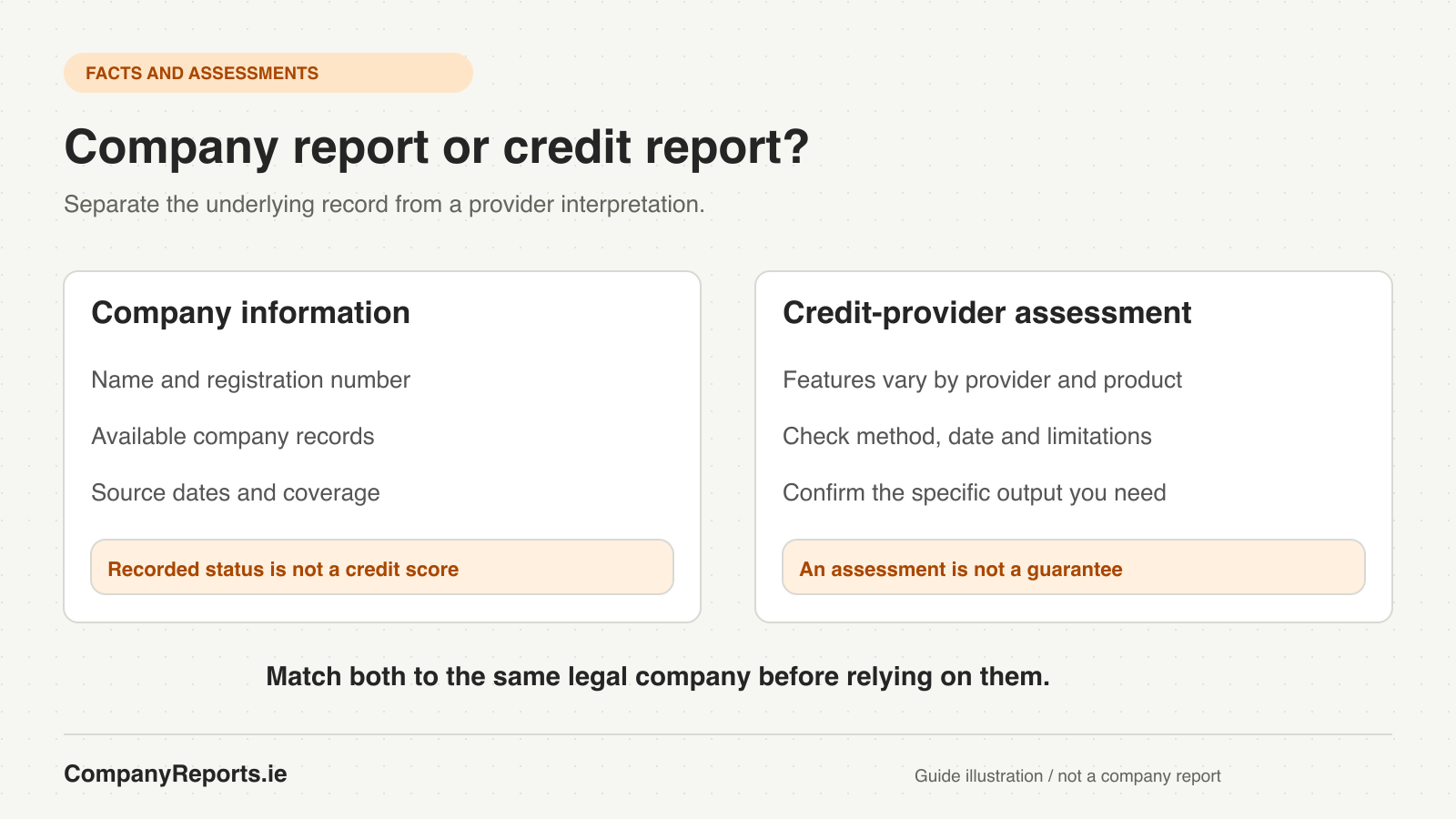
A company information report starts with the record
Company identity is the foundation of any report. The legal name, registration number and available registration details connect the evidence to the entity you are researching. Officer and filing information may add context where included. These are useful inputs, but a collection of company facts does not automatically contain an assessment of the likelihood of repayment.
For example, a status recorded as active or normal is a registration fact, not an instruction to extend credit. Likewise, company age does not establish current cash or payment behaviour. CompanyReports.ie explains these boundaries in its data methodology. Keep the original meaning of each field instead of turning a convenient label into a conclusion the source does not support.
A business credit report may add a provider assessment
Credit-report providers describe products with their own information coverage and assessment features. Experian's Irish business service describes credit scoring and payment data as tools for credit-risk assessment, while CRIF describes company and credit information offerings. Their descriptions illustrate why a credit product should be examined on its own terms rather than treated as another name for a public company profile.
If you need a score, payment information or suggested credit limit, establish whether those features are actually offered for the selected entity. Ask how the output is dated and what limitations apply. A provider assessment is an interpretation under that provider's approach, not the legal identity of the business and not certainty about how a future transaction will turn out.
Compare what you receive, not just what the product is called
A title such as full report does not tell you whether the document contains original accounts, selected financial figures, a proprietary score or a legal opinion. Product descriptions can use similar terms for different bundles. Compare the actual outputs and evidence dates before comparing prices, particularly if one missing field would make the purchase unsuitable for your question.
This is not a comparison of providers' performance or a ranking of their products. It is a way to avoid mismatched expectations. Keep a short checklist for the specific transaction: identity, relevant records, required assessment, evidence dates and unresolved issues. Choose the product that supplies the required output rather than the label that sounds most comprehensive.
| Item | What it is | Question before purchase |
|---|---|---|
| Company registration details | Identity and recorded company information | Does it match the contracting entity? |
| Financial statements | Reported financial-period evidence | Which period and company boundary are included? |
| Credit score, if supplied | A provider's assessment output | What method, date and limitations apply? |
| Suggested credit limit, if supplied | A provider recommendation | Is it included and how should it be interpreted? |
| Your commercial approval | A decision under your own process | Who has reviewed the evidence and accepted the exposure? |
Worked example: registration is not a credit approval
Consider a fictional wholesaler reviewing a new customer that requests 30-day payment terms. A free profile confirms the legal identity and recorded status. That answers an important question about who the customer is. It does not establish how much unsecured exposure the wholesaler should accept or whether this customer's next invoice will be paid on time.
The wholesaler's process may require a provider assessment, current information or further review, depending on the proposed transaction. The company report can support identification and document context without pretending to fulfil every part of that process. A better internal note states which questions the record answered and which commercial approval steps remain open.
If a provider supplies a suggested credit limit, preserve the assessment and its date with the review. Do not silently substitute it for the decision-maker's approval or assume it covers a different company within the group. This fictional scenario explains evidence boundaries, not an appropriate credit amount for any business.
A current assessment can still use historical information
Check the dates behind a report. A recent assembly or assessment date does not make every underlying financial figure current. A balance sheet still describes its stated reporting date. If the document includes several types of evidence, retain the dates for each rather than assigning the newest date to the whole collection.
Also distinguish lack of evidence from a favourable result. A missing figure, incomplete listing or unavailable data feed is an information limit, not a reason to invent a score or regard the business as low risk. Describe what you could inspect and seek clarification where the gap matters. A material decision can require professional interpretation and current information beyond a purchased report.
Where CompanyReports.ie fits in the research process
CompanyReports.ie provides searchable Irish company profiles and a separate PDF company-report purchase. The current full PDF price is EUR 11.99 in total. Individual filing documents, where offered, are separate items with their own prices. The service does not promise that every report includes a credit score, recommended credit limit, payment-history assessment or complete financial statements.
That makes defining the question especially useful. If you want to establish a supplier's company identity and inspect available company information, start with its profile and review the report description. If your process specifically requires a credit-provider assessment, confirm that requirement and obtain the appropriate product instead of expecting it to appear in a company-information PDF.
Record a conclusion that matches the evidence
A useful review note separates findings from decisions. It might state that the company identity was matched, specified documents were inspected and any additional assessment was obtained from a named source on a given date. It then identifies what remains unanswered and who is responsible for the next decision. This preserves context when someone revisits the research later.
Avoid unsupported statements such as guaranteed safe, fully approved or certain to pay. A score, a filing and a company status each have a defined scope. For significant exposure, use appropriate professional advice and current supporting evidence. A company report is an input to a reasoned review, not a promise about the outcome of your transaction.