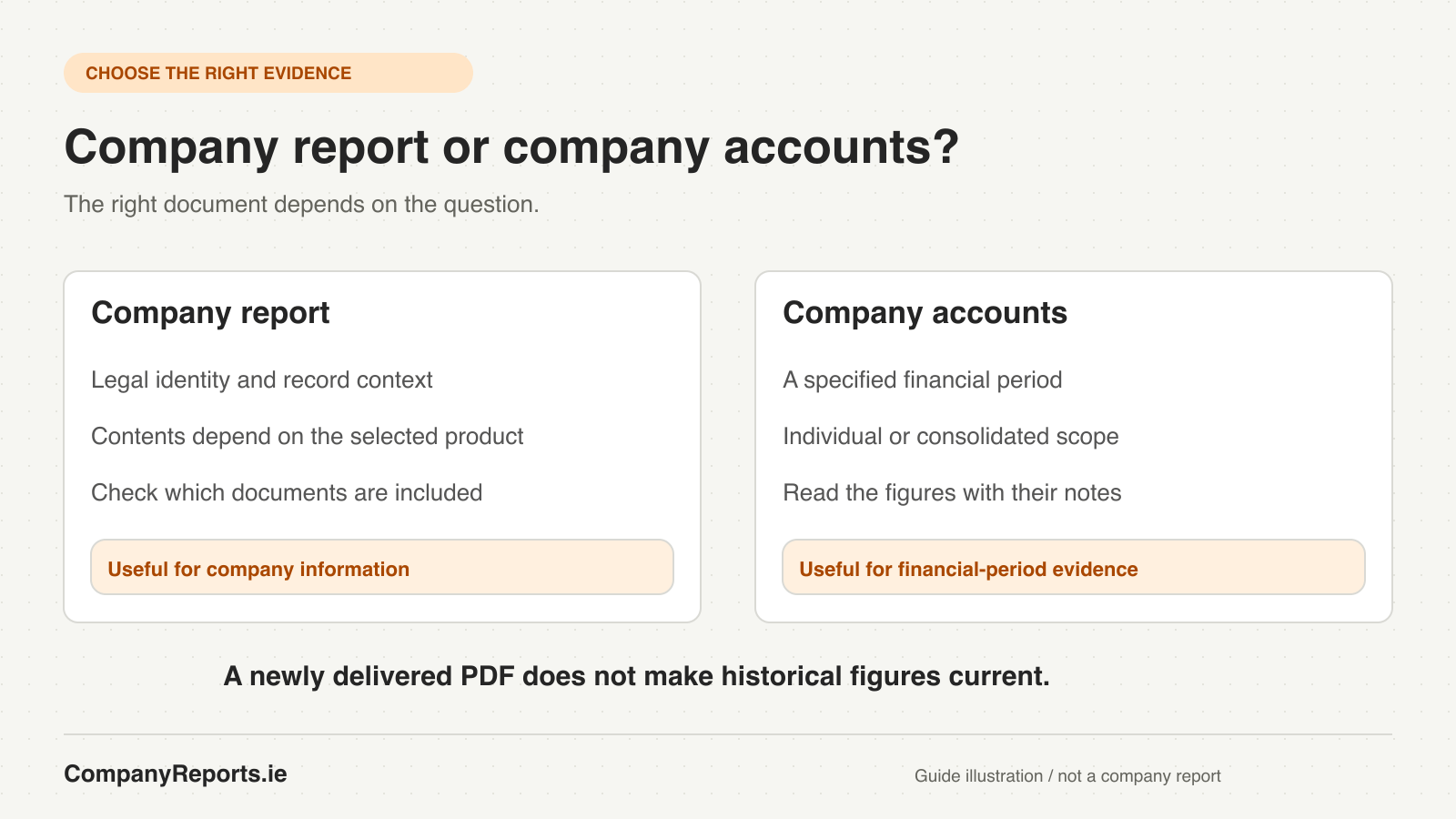
What an Irish company report is useful for
The phrase company report can describe several products. A company information report generally aims to organise facts about the legal entity and its available record. Depending on the description, that can involve registration details, officers or filing information. The label does not establish that every possible document, financial measure or ownership investigation is included.
At CompanyReports.ie, free profiles provide a starting point for identification and the paid PDF is a separate order for fuller company information. Use the selected company's order description to establish the actual scope. If your question is whether two documents refer to the same business, a clear company identity may matter more than a large collection of financial figures.
What company accounts tell you instead
Financial accounts describe a company or group's reported financial information under its stated accounting framework. Their reporting date and period are essential. Public filings can have different levels of disclosure because the applicable requirements and exemptions vary. The official financial-statement guidance is the appropriate starting point for those distinctions, not the assumption that every public document contains identical detail.
For a practical review, identify the balance-sheet date, period covered, currency, units and entity boundary. A number shown in thousands is not the same amount as a number shown in whole euros. Group statements should not be treated as the individual contracting company's finances. Read the notes alongside the headline totals and keep the full document available for context.
Company report or accounts: a side-by-side comparison
The distinction is not that one product is universally better. It is that they have different evidence boundaries. An overview can help you navigate a company's available record, while the accounts are the document to inspect when the question depends on a particular financial statement or note. Sometimes the most useful approach is to use both, with the company number connecting the research.
Before ordering, translate a broad request such as 'get the company financials' into a precise item. Specify which legal entity, which period and which document or figure you need. That small step can prevent ordering a general report and only later discovering that the underlying accounts required for the review were a separate purchase.
| Question | Useful starting point | Scope check |
|---|---|---|
| Which legal company is this? | Company profile or information report | Exact name and registration number |
| What officer or filing information is available? | Selected company report and record listing | Contents, coverage and relevant dates |
| What assets and liabilities were reported? | Accounts for the specified period | Balance-sheet date, units and notes |
| Can the company pay an invoice today? | Current evidence alongside historical records | Neither document alone proves current capacity |
Worked example: the missing reporting period
Imagine a fictional buyer researching a supplier before a new contract. The buyer asks for a company report, but the finance colleague actually needs the balance sheet for the year ended 31 December 2025. The company overview may be useful for identity and filing context, yet it will not answer that exact request unless its contents include the relevant statements or sufficiently specified information.
A clearer instruction would identify the supplier by company number and request accounts for the stated year-end, with individual rather than group scope if that is what the decision requires. The overview can remain part of the research file. This is not a criticism of either product: the problem was buying before defining the evidence required.
If the requested accounts cannot be located, record that limitation and ask about availability before committing to a purchase dependent on them. Do not substitute the parent's consolidated statements without explaining the changed scope. All entities and dates in this scenario are illustrative; no actual company is being assessed.
Do not confuse a filing summary with the original document
A listing, timeline or report entry can help you identify a document, but it is not necessarily the document itself. If a question turns on wording in a note, the audit report or an exemption statement, inspect the underlying filing. A summary is useful for navigation; it should not be expanded into a claim about text you have not actually read.
Likewise, absence from one feed does not establish absence from the official record. Listings can be incomplete or temporarily unavailable. Preserve the source and lookup date, and distinguish 'not located in the source inspected' from 'does not exist'. That distinction is especially important when sharing a review with someone who did not perform the search.
Historical accounts and a new report have different clocks
A report assembled today can include financial information from an older period. Compilation date, record update date and financial year-end answer different questions. Do not describe a historical cash figure as money available today simply because the PDF arrived this morning. Keep the underlying reporting date beside any number you reuse.
For a material decision, consider which developments since that date need clarification. New borrowing, changed operations or a significant event may affect how useful the historical evidence is. Ask for information proportionate to the decision and seek appropriate professional interpretation when necessary, rather than expecting one purchased document to remove all uncertainty.
Choose your evidence on CompanyReports.ie
Search for the company, match the identity and review its free profile first. Then decide whether the EUR 11.99 PDF company report or an individually priced filing fits your question. The report and any document order should be treated as the items described at checkout, not as a promise that all historic accounts or every available filing will be supplied together.
Reports are delivered by email, with a usual window of 10 minutes to 3 hours during business hours; unusual records or interruptions can take longer. Read the delivery information and use a correct purchase email. If a particular document is essential, confirm its availability and the intended period before paying rather than relying on a general product label.