Latest filed does not mean current financial information
The word latest usually means the newest document found within a particular source. It does not mean that all transactions up to today are included. A balance sheet records a position at its stated date, while an income statement covers its stated period. A document downloaded this morning can still describe a financial year that ended long ago.
Look inside the PDF before using the figures. A search listing may emphasise the filing date because that is when the document entered the system. For financial comparison, the reporting period matters more. Also check whether the document is an annual return, financial statements, an amendment or a different filing; a newly dated entry is not necessarily new accounts.
The practical distinction is between evidence availability and evidence freshness. Availability asks what you can inspect. Freshness asks how closely the evidence relates to your decision date. An older but complete statement can be useful for historical analysis while being insufficient to establish current payment capacity. Label both dimensions rather than dismissing the document or overstating what it tells you.
The five dates to separate when reviewing accounts
Start with the financial year-end, then identify when the accounts were approved. Where an audit exists, record the auditor's report date too. The annual return has its own date and the document has a submission or filing history. Finally, record when you performed your review. These dates describe different steps, not five competing versions of the company's financial position.
Approval and audit can involve information considered after the reporting period, but they do not turn every year-end number into a balance at the later date. Read the notes about subsequent developments separately. A new approval date is therefore not a reason to relabel historical cash as current cash or to assume no significant change has occurred since the statements were signed.
| Date | What it identifies | Common mistake |
|---|---|---|
| Financial year-end | The balance-sheet reporting date | Using the filing date as the cash measurement date |
| Approval date | When the statements were authorised | Treating all figures as balances on that day |
| Auditor's report date, if applicable | The date of that audit report | Assuming an audit guarantees future payment |
| Annual return / filing dates | The relevant return and delivery history | Treating a new return as a new financial year |
| Review date | When you assessed the available evidence | Omitting how much time has passed |
Why Irish annual accounts can appear months after year-end
Annual financial reporting is not real-time reporting. The company prepares statements after the period ends and completes the relevant approval and filing process. Official guidance links the financial statements attached to an annual return to its annual return date, including the general nine-month relationship between the reporting date and the date to which the return is made up. Filing timing is a separate consideration.
Do not calculate a company's compliance position from a generic calendar alone. Annual return dates and financial year-ends can change through permitted procedures, and exemptions or particular circumstances can affect the documents required. Check the actual company's record and current official guidance before concluding that a filing should already be present.
New companies also require context. The official guidance states that the first annual return is due six months after incorporation and does not require financial statements. Seeing an early return with no accounts therefore need not indicate a gap or concealment. Company age, the return type and the expected reporting period all matter to a fair interpretation.
Worked example: a newly filed document with older figures
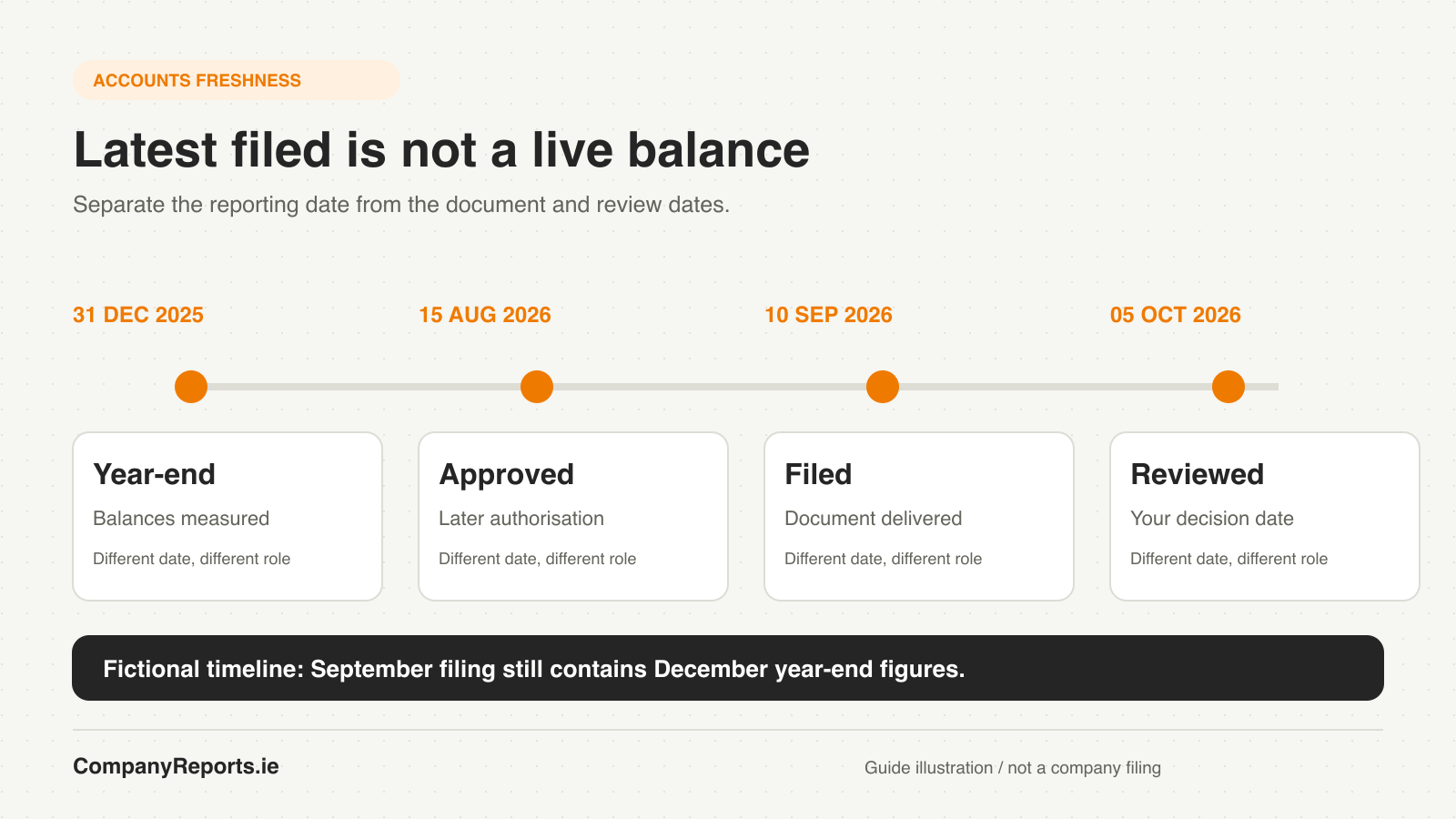
Imagine a fictional company whose financial year ends on 31 December 2025. Its accounts are approved on 15 August 2026 and filed on 10 September 2026. You review the company on 5 October 2026. The document is recently filed, but its balance sheet still describes 31 December 2025. None of these illustrative dates establishes the timetable for a real company.
If the balance sheet shows EUR 40,000 of cash, the defensible statement is that the company reported that amount at the year-end. It is not that the company has EUR 40,000 today. Sales, collections, loan payments or new funding may have changed its position. The approval date and subsequent-events notes can add context without supplying a complete October bank balance.
Now suppose the newest document your data feed returns is the previous year's accounts. Before declaring the company overdue, establish whether the feed is current and complete and whether the relevant filing has actually become due. A source outage can create an availability problem even where documents exist elsewhere. Separate that technical limitation from any verified filing-status finding.
Missing accounts, unavailable listings and late filings are different
A document not located in your search is a result of that search, not proof of non-filing. The source may have limited coverage, the requested company number may be wrong or the entry may be a different document type. A cache can also lag behind the originating record. Where the filing listing is temporarily unavailable, say that availability could not be established.
To investigate, confirm the company number, inspect the available official filing history and compare the relevant dates and document types. If a deadline matters, establish the actual return date and applicable requirements. Preserve the lookup date and source. Do not publish a claim that a business is late based solely on an empty list or a failed API request.
A revised filing introduces another distinction. It may replace or correct a document for an existing financial period rather than add a new year's results. Read the revision context and identify which version you used. Two entries with recent dates can describe the same period; counting entries is not the same as counting financial years.
How to bridge the gap between filed accounts and today
Begin with the decision you are making. A small routine purchase and a large unsecured credit commitment do not require identical evidence. For a material exposure, ask the counterparty for information relevant to the gap: recent management figures, an explanation of material changes and evidence of funding or payment arrangements where those matters affect the decision.
Distinguish historical actual results from forecasts. A forecast can help explain management's expectations, but it is not evidence that the predicted sales or cash have already arrived. Likewise, unaudited management information has a different status from statutory accounts. Record who supplied it, the period it covers, any limitations and whether it reconciles with the earlier statements.
Use questions that can be answered concretely. Has a major customer been lost? Has a facility expired or been renewed? Have ownership or operational arrangements changed? What supports an explanation of improved collections? These are review prompts, not accusations. The purpose is to close a relevant information gap, not to treat every old filing as a warning sign.
- What reporting period does the new information cover?
- Is it actual performance, an estimate or a forecast?
- Who prepared it and what supporting evidence is available?
- Does it explain significant movements since the filed year-end?
- Which unresolved assumptions matter to your proposed exposure?
Use older accounts carefully in a company report
Historical accounts remain useful for understanding trends, funding structures and previously disclosed risks. Compare periods with the same scope, currency and length where possible. A change from individual to group accounts, or a longer financial period, can distort apparent growth. Explain those differences instead of presenting an unqualified percentage comparison.
A clear conclusion might read: 'Accounts for the year ended 31 December 2025 were inspected on 5 October 2026. Current cash and trading performance have not been independently verified.' This states the evidence boundary without pretending the company is either sound or distressed. Add any later evidence separately and identify which questions it answers.
Before purchasing a report or filing, confirm its stated contents, document period and delivery arrangements. Buying access to a historical document does not transform it into live financial monitoring. Search the company by its exact name or number, review what is available and order the evidence that addresses your question, rather than simply choosing the entry with the newest display date.