How to calculate negative net assets
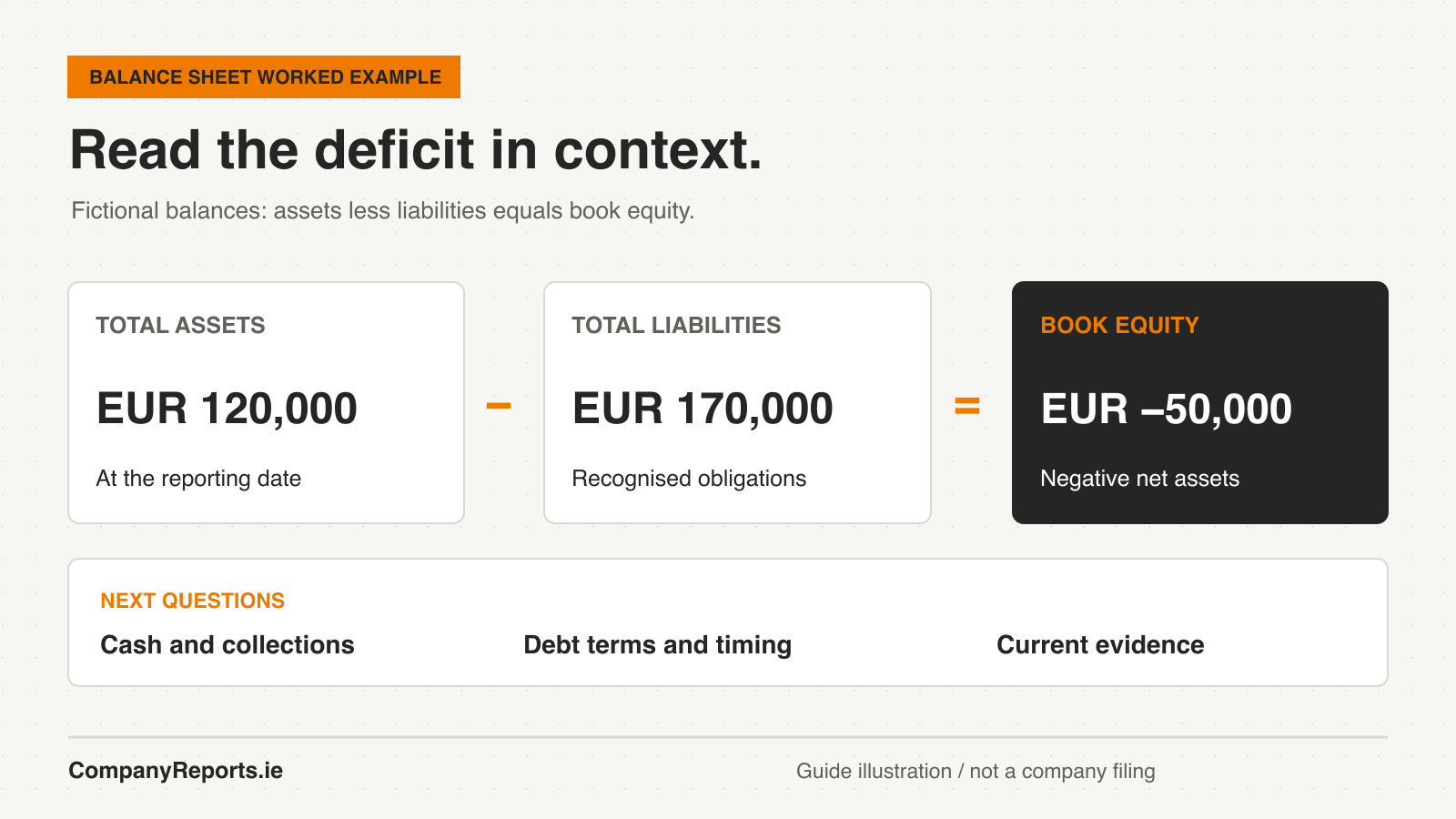
For a simplified balance sheet, subtract total liabilities from total assets. If assets are EUR 120,000 and liabilities are EUR 170,000, the result is negative EUR 50,000. This describes book equity under the accounting presentation used. It does not state the sale price of the business or how much money is currently in its bank account.
Some statements present net assets or liabilities directly; others show assets less current liabilities before deducting further liabilities. Read the full layout. Treating an intermediate subtotal as final net assets can miss long-term creditors or provisions. Also check whether brackets indicate a negative figure and whether the amounts are expressed in thousands.
| Item | Amount | Reading |
|---|---|---|
| Total assets | EUR 120,000 | Recognised resources at the balance-sheet date |
| Total liabilities | EUR 170,000 | Recognised obligations in this example |
| Net assets / liabilities | EUR -50,000 | 120,000 minus 170,000 |
| Book equity | EUR -50,000 | The same residual in this simplified presentation |
Negative equity is different from negative working capital
Working capital compares current assets with current liabilities. Net assets compare all recognised assets with all recognised liabilities. A company can have positive total net assets while facing a deficit among balances classified as current. The distinction matters because a long-lived asset may not supply cash in time for an imminent payment.
Even current assets are not all immediately spendable cash. Inventory may take time to sell, and a customer receivable may be disputed or collected late. Likewise, the maturity and terms of obligations affect the cash timetable. A ratio is a starting calculation; the underlying timing and recoverability determine how useful it is.
| Measure | Calculation or evidence | Question |
|---|---|---|
| Net assets | Total assets less total liabilities | What book equity is reported at this date? |
| Net current assets | Current assets less current liabilities | What is the balance of the classified current items? |
| Payment capacity | Cash, collections, facilities and payment timing | Can obligations be met when they fall due? |
Worked example: positive net assets with a cash concern
Consider a fictional company with equipment of EUR 250,000 and current assets of EUR 50,000. Total assets are EUR 300,000. Current liabilities are EUR 100,000 and long-term liabilities are EUR 80,000, giving total liabilities of EUR 180,000 and positive net assets of EUR 120,000. However, current assets minus current liabilities gives negative working capital of EUR 50,000.
If current assets include only EUR 5,000 of cash and the remainder is inventory and receivables, the positive equity figure cannot tell you whether next week's invoice will be paid. Collections, payment schedules and available funding are unanswered questions. This is why a reviewer should resist treating positive net assets as a universal green light.
The reverse also requires context. A company with negative book equity may have funding arrangements or support that matter to its position. Examine the evidence and enforceable terms of any claimed support rather than treating a management statement as equivalent to committed cash.
What can cause a net-assets deficit?
Accumulated losses can reduce reserves over time. Distributions, asset impairments, provisions and other accounting adjustments can also affect equity, depending on the facts and framework. Read movements in reserves and the available notes to determine which explanation is supported. A deficit alone does not identify its cause.
A director's or shareholder's loan is particularly easy to misread. The advance can provide cash while remaining a liability; it does not become equity because the lender owns the company. Repayment terms, any subordination and the strength of the supporting party can matter to a review. A conversion of debt to equity requires the actual transaction and its treatment, rather than a verbal assurance that repayment will not be requested.
Compare periods consistently. If a deficit narrowed, ask whether operations improved, funding changed or accounting adjustments drove the movement. If the reporting scope changed, a year-to-year comparison may need a separate explanation. Preserve both the numbers and the cause supported by the notes.
Does negative net assets mean that a company is insolvent?
It is not appropriate to make a definitive legal insolvency finding from one historical accounting total. Book values, realisable amounts, the obligations included, payment timing and current developments may all require examination. The Corporate Enforcement Authority's guidance describes insolvency concerns involving the ability to pay debts as they fall due and emphasises the importance of accurate financial records.
Treat a deficit as a reason to investigate rather than a label to apply publicly without context. Ask an appropriately qualified adviser to assess a material situation, especially where payment defaults or other evidence accompanies the figures. Negative equity and liquidity pressure can overlap, but neither a simple subtraction nor a company-status label provides a complete legal analysis.
Which notes and current evidence should you examine?
Look for accounting policies, impairment explanations, creditors, related parties, security, guarantees and events after the reporting date where these are disclosed. Read any going-concern discussion and the auditor's report or exemption information. An audit opinion has a defined scope and date; it does not remove the need to understand current developments.
For a supplier or customer review, request evidence proportionate to the proposed exposure. Examples include current management information, explanations of overdue balances and substantiation of claimed financial support. Do not treat an undated forecast or an unsigned assurance as equivalent to a confirmed arrangement. Record what you could inspect and what remains uncertain.
- What portion of assets is cash, recoverable receivables or saleable inventory?
- When do material debts and commitments fall due?
- Do the notes explain movements in reserves or provisions?
- What evidence supports any claimed funding or shareholder assistance?
- Have important events occurred since the financial year-end?
- What current payment experience and professional review are available?
Use the finding in a measured commercial decision
Write a conclusion that matches the evidence: for example, 'the accounts show negative book equity at the stated year-end; current payment capacity has not yet been established'. That is more useful than a blanket claim that the business is unsafe. Connect the finding to the value, duration and reversibility of your proposed commitment.
Depending on the evidence, your review may lead to further questions, smaller exposure, revised payment arrangements or specialist advice. Keep those decisions separate from the arithmetic. A company report can organise the identity and available history around the accounts, but it should not be treated as a guarantee of solvency or future payment.