What does abridged mean in an Irish company filing?
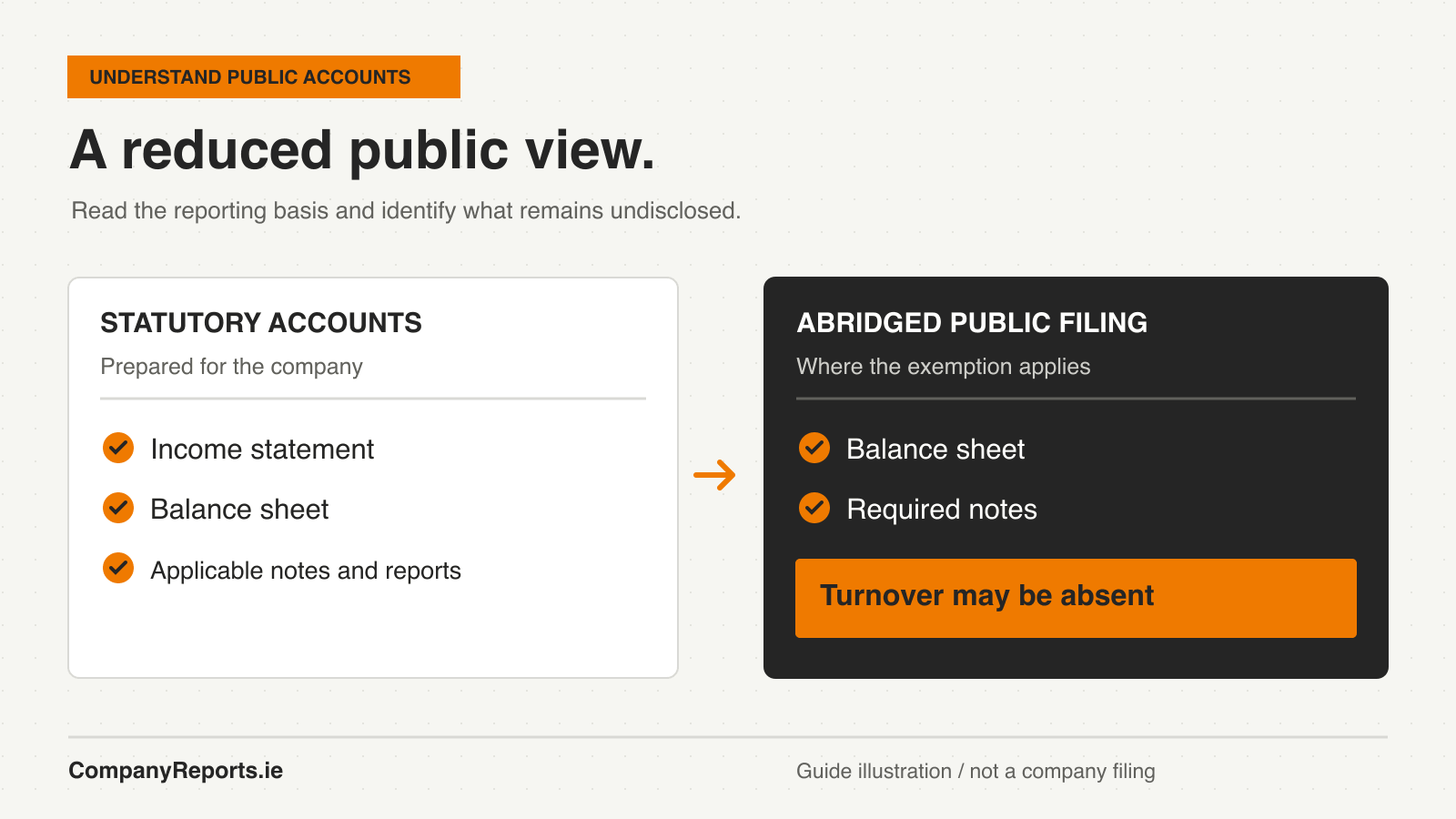
CRO's small-company guidance explains the statutory abridgement route: qualifying companies can deliver specified abridged financial statements instead of the fuller documents that would otherwise accompany the annual return. The requirements include a balance sheet and applicable notes, with additional requirements depending on the framework and circumstances.
For a reader, the practical implication is narrower public disclosure. An abridged filing is not the same thing as a company's complete internal accounting records. Its length also tells you little by itself: a short document can include the required disclosures, while a longer file can contain pages that do not answer the specific question you are investigating.
What can you see, and what may remain undisclosed?
The exact contents depend on the company, reporting framework and exemptions used. Read the complete filing rather than relying on a universal checklist. A balance-sheet total can be available while the detailed income statement needed to establish revenue and margins is absent. Notes can explain a headline balance, but not every category of note applies to every filing.
The comparison below is a reading aid rather than a statutory filing checklist. 'May be available' means you must inspect the document; it does not promise that the information exists for every company. This distinction is particularly important when a search tool has empty revenue fields or offers several documents with similar descriptions.
| Question | Abridged public filing | What to do next |
|---|---|---|
| What were assets and liabilities at year-end? | A balance sheet can provide the reported balances | Read the units, date and related notes |
| What was turnover? | A complete revenue figure may be absent | Look for a relevant note or request the appropriate accounts |
| How profitable was the trading activity? | The full profit and loss account may be absent | Do not infer annual profit from accumulated reserves |
| What is the current cash position? | A year-end balance is historical | Request current evidence for a present-day decision |
| Was an audit performed? | The audit or exemption wording must be checked separately | Read the relevant report or statement |
Abridged accounts and audit exemption answer different questions
Abridgement concerns public filing content. Audit exemption concerns whether a company may avoid a statutory audit under the applicable conditions. A company can qualify for one exemption while its position on the other differs. Therefore, the word 'abridged' alone cannot tell you whether an audit was performed.
Check the actual auditor's report or exemption statement and use current official guidance if you need to assess entitlement. Company size is not the only consideration. For a buyer of information, it is normally more useful to record the stated reporting and audit basis than to attempt a legal determination from a few financial totals.
An audit does not convert historical statements into a guarantee of future payments. Equally, an audit-exempt filing is not automatically evidence of unreliable accounting. The appropriate question is what assurance and information this document provides for the decision in front of you.
Read micro-company and small-company wording carefully
The micro-company category has its own conditions and disclosure provisions. CRO guidance describes circumstances where a qualifying micro company using both audit and abridgement exemptions files a balance sheet and notes, with reduced note requirements. A micro filing should not be treated as though it necessarily provides the same disclosure as a larger company's accounts.
Read the wording in the document instead of estimating the category from a company name, number of staff listed online or one financial balance. Eligibility tests can depend on multiple conditions and more than one year. If the legal entitlement matters, consult the current requirements and an adviser rather than treating a public-account summary as a compliance opinion.
Worked example: what one short balance sheet lets you calculate
Imagine a fictional filing with total assets of EUR 210,000 and total liabilities of EUR 150,000. Net assets are EUR 60,000. Suppose current assets are EUR 90,000 and current liabilities are EUR 70,000: the example also has net current assets of EUR 20,000. These are calculations from the stated balances, not assumptions about annual sales.
If no income statement or turnover note is present, revenue remains undisclosed. Nor does EUR 60,000 in net assets establish the company's sale value or cash balance. Assets can include equipment, receivables or other items, and liabilities can have different maturity dates. Read the composition and notes before turning the totals into a commercial conclusion.
| Evidence | Calculation or finding | Limit |
|---|---|---|
| Assets EUR 210,000; liabilities EUR 150,000 | Net assets EUR 60,000 | This is book equity, not a business valuation |
| Current assets EUR 90,000; current liabilities EUR 70,000 | Net current assets EUR 20,000 | Recoverability and timing still matter |
| No disclosed revenue figure | Turnover not established | Missing disclosure is not zero turnover |
| No current management information | Present-day trading not established | Historical figures do not supply today's position |
How to handle missing information before a contract or credit decision
Begin with the risk you need to resolve. For a small, reversible order, legal identity and reliable payment controls may matter more than an elaborate financial model. For substantial credit, a long contract or an acquisition, ask for the current financial evidence needed to test the proposed commitment.
Make the request specific: the individual company's relevant accounts, the reporting period, explanations of material balances and current information where historical figures are insufficient. A group annual report may add context while still leaving the contracting subsidiary's position unclear. Mark supplied management information separately from the filed record.
Avoid treating reduced disclosure itself as proof of distress or dishonesty. The useful finding is that a particular question remains unanswered. Decide whether you can proceed with controls, need more evidence or should obtain professional review, and record the reason.
Can buying a company report reveal everything missing from abridged accounts?
A report can help organise identity, available filings and other company evidence. Its value depends on its sources and the contents described for the product. It should not be assumed to contain undisclosed turnover, private management accounts or a complete set of original documents merely because it is paid for.
Before ordering, establish which documents or information are included, the relevant periods and delivery arrangements. Keep any estimates clearly identified. Combining a report with the original available accounts and information requested directly from the company provides a more useful review than silently filling empty fields.