Where should you look for an Irish company's turnover?
Search by the company's legal identity, locate the financial statements and inspect the income statement and relevant notes. The heading can be turnover, revenue or another description appropriate to the activity. Read the revenue policy to understand the recognition basis and whether the business acts as principal or agent. Do not assume that every customer payment passing through a business is its reported revenue.
For a listed group, an investor-relations annual report may provide additional detail. However, a group figure includes a different reporting boundary from the individual Irish subsidiary you may be assessing. Record the entity and scope alongside the number. 'The group reported revenue of X' is a different statement from 'this contracting company reported turnover of X'.
Why turnover may be missing from public accounts
A company can prepare statutory accounts while delivering a reduced public filing under an applicable exemption. CRO's abridgement guidance describes the balance sheet and required notes included in qualifying small-company filings. The public document may therefore lack a complete profit and loss account and a usable turnover line.
If you cannot see revenue, report the limitation as 'turnover not disclosed in the document reviewed'. That is more accurate than entering zero in a comparison sheet. Before concluding that the figure is unavailable, inspect the notes, check whether you selected a return rather than financial statements, and look for another relevant published report.
A commercial provider may publish an estimate or an older figure from another source. Such a number should retain its source, date, entity and estimation label. Buying another summary of the same abridged document does not automatically reveal information that the document never contained.
Worked example: turnover, operating profit and cash
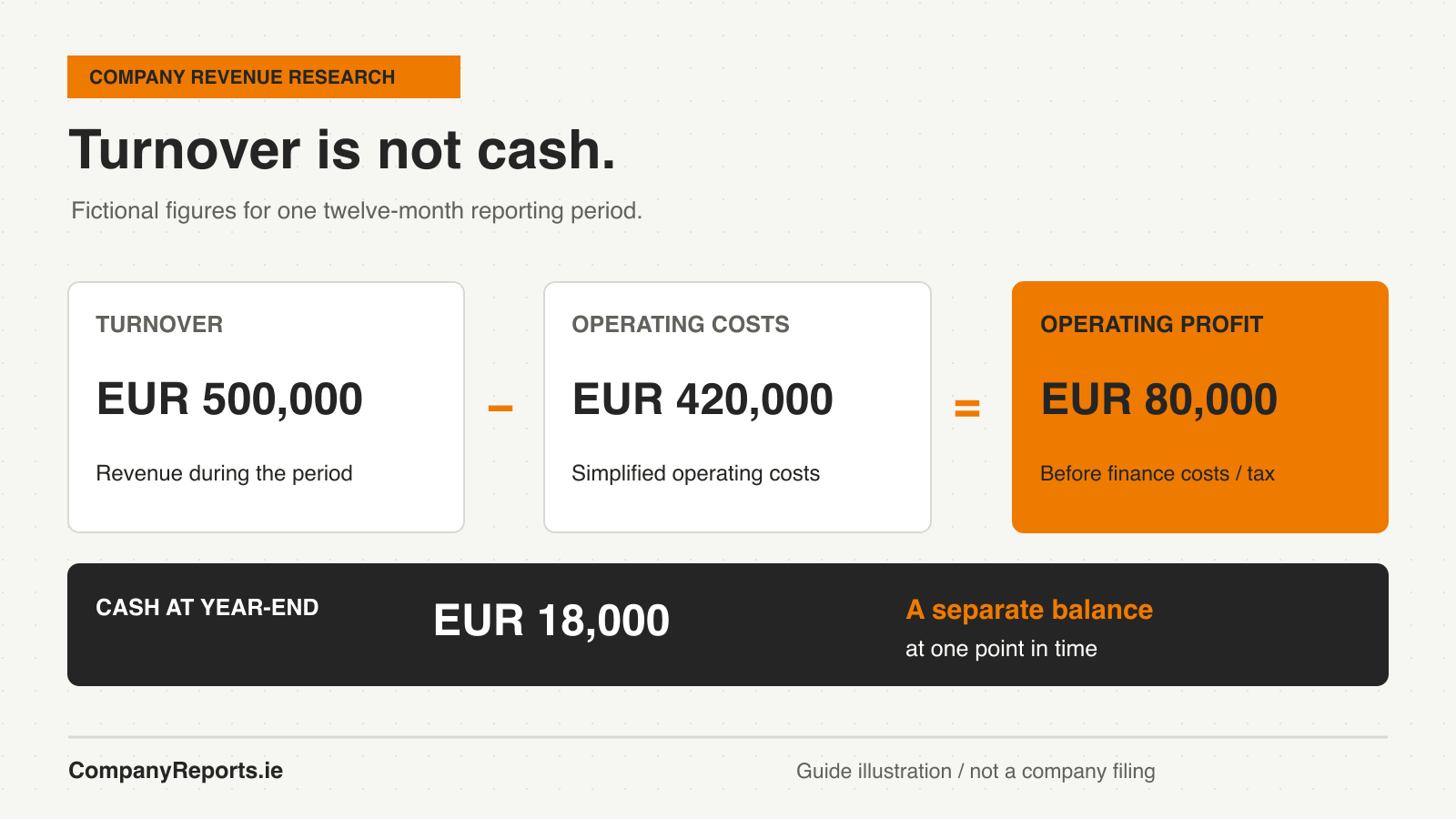
Consider an invented company with turnover of EUR 500,000 and operating costs of EUR 420,000 in the same twelve-month period. On that simplified basis, operating profit is EUR 80,000. Finance costs and tax have not yet been deducted. If cash at the year-end is EUR 18,000, none of the other figures tells you that the company has EUR 500,000 available to spend.
The amounts measure different things. Revenue can be recognised before customers settle their invoices. A business may use cash to buy equipment, repay debt or build inventory. Conversely, a loan can increase cash without creating revenue. The balance-sheet date and cash-flow information help explain why reported sales and money available for payments diverge.
| Measure | Example | What it answers |
|---|---|---|
| Turnover | EUR 500,000 | Revenue recognised during the period |
| Operating costs | EUR 420,000 | Costs deducted in this simplified operating result |
| Operating profit | EUR 80,000 | Turnover less operating costs, before finance costs and tax here |
| Cash at year-end | EUR 18,000 | A balance at one date, rather than the period's revenue |
Calculate growth only after checking the comparison
Using fictional, comparable figures, turnover of EUR 500,000 after EUR 400,000 represents growth of 25%: subtract 400,000 from 500,000, divide by 400,000 and multiply by 100. This calculation says nothing by itself about margins, cash collection or whether the next year will grow. If the earlier value is zero, that percentage calculation has no valid denominator.
Check period length before drawing conclusions. EUR 600,000 over eighteen months is not automatically stronger annual performance than EUR 500,000 over twelve months. Simple annualisation of the longer period gives EUR 400,000, but that is an illustration rather than an observed twelve-month result; seasonal activity can make annualising misleading.
Also check acquisitions, disposals, currency movements and restated comparatives. A jump caused by adding a subsidiary is different from growth in the existing operation. Present the arithmetic alongside these limitations, and keep the original figures rather than silently replacing them with adjusted estimates.
- Use the same company or explicitly the same consolidated group.
- Match currency and units before calculating.
- Compare period lengths and year-end dates.
- Check whether the comparative figures were restated.
- Explain business-scope changes and assumptions.
Why you cannot reconstruct turnover from a balance sheet
A balance sheet describes balances at a date; turnover measures activity over a period. Receivables depend on credit terms, payment timing, recoverability and other items included in the balance. Cash reflects borrowing, spending and collection as well as sales. Neither provides a reliable conversion into annual revenue without substantial additional evidence.
Similarly, retained earnings can accumulate across years and change through losses, distributions or other adjustments. Multiplying employee numbers by a guessed sales-per-person figure creates an estimate, not a public-record fact. Company size categories also do not disclose an exact turnover: eligibility depends on multiple conditions, and different combinations can apply.
When evaluating a credit request, a range built from assumptions may be less useful than a direct request for a dated turnover figure supported by appropriate records. Distinguish what the company supplied, what the filed statements show and what you calculated yourself.
What to request when the public number is unavailable or too old
Define the commercial question first. If you are setting a credit limit, ask for evidence about current sales, collections and obligations rather than treating last year's revenue as payment capacity. If you are reviewing an acquisition, reconcile the claimed turnover with the reporting entity, accounting period and supporting records through your advisers.
A focused request identifies the desired period, currency, individual or group scope and whether the figures are final or provisional. A company may share management information under suitable confidentiality arrangements. Receiving such information does not turn it into an independently verified filing; keep its status clear in your decision file.
- Ask for the relevant period and the exact legal entity.
- Distinguish final statutory accounts from provisional management figures.
- Request explanations for substantial year-to-year changes.
- Check collection and cash information where payment risk matters.
- Retain the source, review date and outstanding questions.
Turn the number into a useful company review
A strong review records the turnover figure with its period, reporting scope, source and limitations. Add profit, net assets and payment experience where available, but keep these measures separate. A high-sales company can have narrow margins, while a smaller company can have sound collections and manageable commitments.
CompanyReports.ie helps you start with the right company and review the available profile and report options. It should not be assumed that every company report contains turnover or that a report supplies undisclosed sales. Check the product description and use the information to support a dated review rather than a claim of certainty.