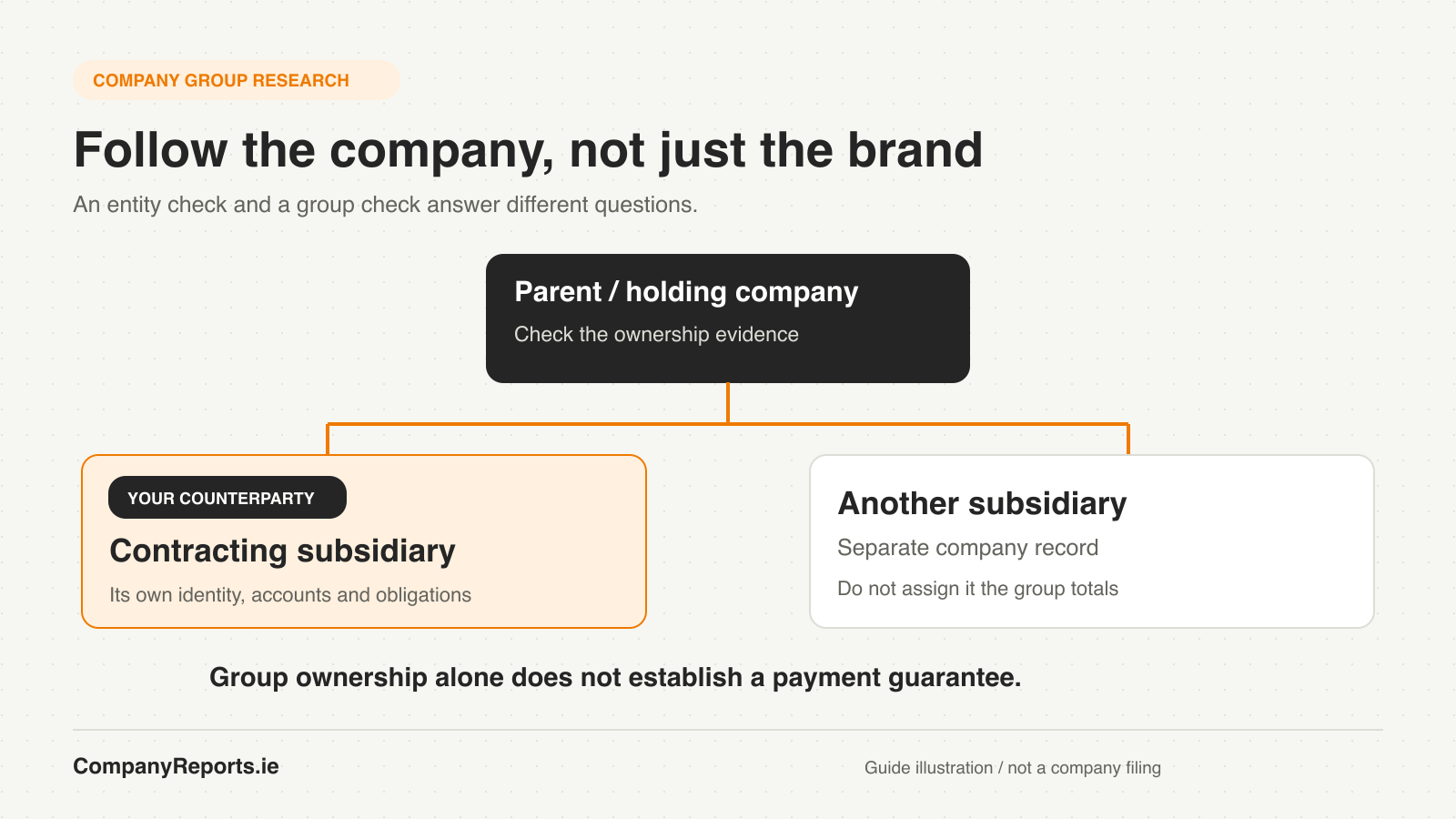
Parent company, holding company and subsidiary: the useful distinction
A parent or holding company sits above another undertaking through an ownership or control relationship. A subsidiary sits below it. For a commercial review, start by treating each company as its own record: separate name, number, reporting documents and contractual role. A trading group may also contain branches or registered business names, which should not automatically be treated as additional incorporated companies.
Do not assume that the parent performs the work you are buying. One company may hold investments, another may employ staff and a third may sell the product. A website presenting them under one visual identity does not explain which entity takes your order. Ask the business to identify the supplier in writing if its quotation or terms are ambiguous.
The first useful output is a small entity map rather than a complicated ownership chart. Put your proposed counterparty in the centre, add any evidenced parent and note the source date. Leave uncertain relationships labelled as unverified. This prevents a plausible connection from becoming a supposed fact as the review is passed between colleagues.
| Label | What to establish | What not to assume |
|---|---|---|
| Brand or trading name | The legal entity using the name | That the brand is a separate company |
| Contracting subsidiary | Name, number and agreement role | That the parent owes its invoices |
| Parent or holding company | The documented ownership or control relationship | That it supplies the contracted service |
| Corporate group | Which entities the evidence covers | That one group figure belongs to every member |
How to find evidence of an Irish company's parent
Start with documents tied to the exact company number. Available annual returns, accounts notes and ownership documents may help identify a shareholder or parent. Read the document itself rather than relying only on a search-result summary. A reported relationship describes the date and scope of that source, not necessarily today's complete structure.
A shareholder and a beneficial owner are different concepts. A corporate shareholder may be another step in the chain rather than the ultimate owner. Similarly, an accounts note identifying an ultimate parent may not supply every intermediate company or ownership percentage. Keep those gaps explicit instead of filling them from names that happen to resemble one another.
If an acquisition announcement suggests the structure changed after the filing date, preserve the announcement as a lead and seek evidence of the completed transaction. Announced, agreed and completed are not interchangeable. For a material contract, ask the counterparty for a current structure explanation and reconcile it to the records you can inspect.
Individual accounts versus consolidated group accounts
Entity accounts describe the company named in those statements. Consolidated accounts present the group within their stated reporting boundary, with consolidation adjustments. The official group-filing guidance explains preparation and filing obligations and applicable exemptions. Read the document headings and accounting policies to establish which view you have before copying a number into your assessment.
A parent can publish both an individual balance sheet and a consolidated balance sheet in one document. The figures may differ substantially. A number labelled group cash does not establish how much cash your contracting subsidiary can use. Restrictions, ownership arrangements and intercompany funding can make the location and availability of resources important questions.
Avoid mixing boundaries across years. If last year's figure is individual revenue and this year's is consolidated revenue, calculating a growth percentage creates a comparison the source does not support. Note currency, units, period length and changes in the reporting group alongside the identity of the accounts. A larger number is not necessarily stronger evidence about the company you will pay.
Worked example: a strong group is not the same as your supplier
Imagine a fictional group with a holding company and two wholly owned subsidiaries. The consolidated accounts show revenue of EUR 8 million. Your purchase order is with the installation subsidiary, not the holding company. The other subsidiary sells equipment. The group revenue does not tell you how much installation revenue was earned, what cash the installer holds or when its own debts fall due.
Suppose the installer reports EUR 15,000 of cash and a balance due to its parent. Those facts invite questions about its funding arrangements and payment timetable; they do not automatically prove a problem. Equally, the parent's recognisable name does not close the questions. You would want evidence relevant to the entity that accepts the work and the size of your proposed advance.
Your review might therefore request the installer's latest available entity accounts, an explanation of current capacity and the exact terms of any claimed support. Write 'group revenue inspected; subsidiary payment capacity not established' rather than assigning the entire group's sales to the installer. The example is deliberately fictional and is not a judgement about any listed business.
Does the parent company guarantee a subsidiary's debts?
Group membership alone is not evidence of a guarantee. A statement that a parent 'supports' a subsidiary may describe an intention, a lending arrangement or an actual legal commitment. Those are not equivalent. Ask which company made the commitment, who can rely on it and which obligations it covers before treating it as a substitute for the subsidiary's own financial position.
There is a specific Irish filing exemption for qualifying subsidiary undertakings under section 357, subject to conditions. Official guidance describes documents including an irrevocable parent guarantee and consolidated accounts. The example guarantee is tied to a specified financial year and scope. Do not assume that an exemption filing supplies unlimited cover for every future contract or that every subsidiary uses this exemption.
For a significant exposure, a solicitor should assess the actual guarantee or proposed contract. Identify the covered entity, relevant period, beneficiary, limits and any conditions. Then consider whether the supporting company can perform its commitment. A well-worded obligation and the resources to honour it are separate questions; neither can be established from a logo or a shared office address.
Read intercompany balances and funding without guessing
Amounts owed to or by related companies can be material to an individual balance sheet. If your supplier has a large receivable from another group member, ask what supports collection and when payment is expected. If it owes the parent, investigate the disclosed repayment terms. An intercompany balance is not automatically cash available to settle your invoice.
Likewise, a subsidiary can rely on shared services, intellectual property or facilities supplied elsewhere in the group. A description of operational dependence helps frame questions but does not establish the legal terms of access. Request explanations proportionate to the transaction rather than demanding confidential documents that are unnecessary for a routine low-value purchase.
Document the difference between what the filing says and what management later explains. If a newer agreement resolves a historical uncertainty, record its date and the evidence you received. If an explanation remains unsupported, do not silently convert it into a verified fact. This makes the review useful when the contract is renewed or the corporate structure changes.
Build a company report around the entity you actually trade with
A good review begins with the proposed contracting company, then expands to the group only where the relationship matters. Save the legal identity, sources, reporting boundaries and outstanding questions together. Check that the final agreement still names the same entity as the quotation you reviewed; a change of supplier company deserves a fresh identity check.
When ordering a company report or filing, confirm which entity and documents the purchase covers. An individual company report should not be presumed to include a complete international group investigation, every subsidiary's accounts or a legal opinion on guarantees. Read the stated contents and delivery arrangements before purchasing, especially where the decision depends on a particular document.
Use related-company discoveries as leads, not conclusions. Search the exact parent or subsidiary separately when needed, and keep the original counterparty visible in your notes. The objective is a defensible account of who you are dealing with, what evidence supports their position and which uncertainties need resolving before money or credit is committed.