What does going concern mean in company accounts?
Going concern is an accounting basis involving continued operation rather than an assumed immediate wind-down. Financial statements prepared on this basis can still describe significant uncertainty. For a reader, the distinction matters: the adoption of the basis is not a promise that operations will be trouble-free or that every creditor will be paid on time.
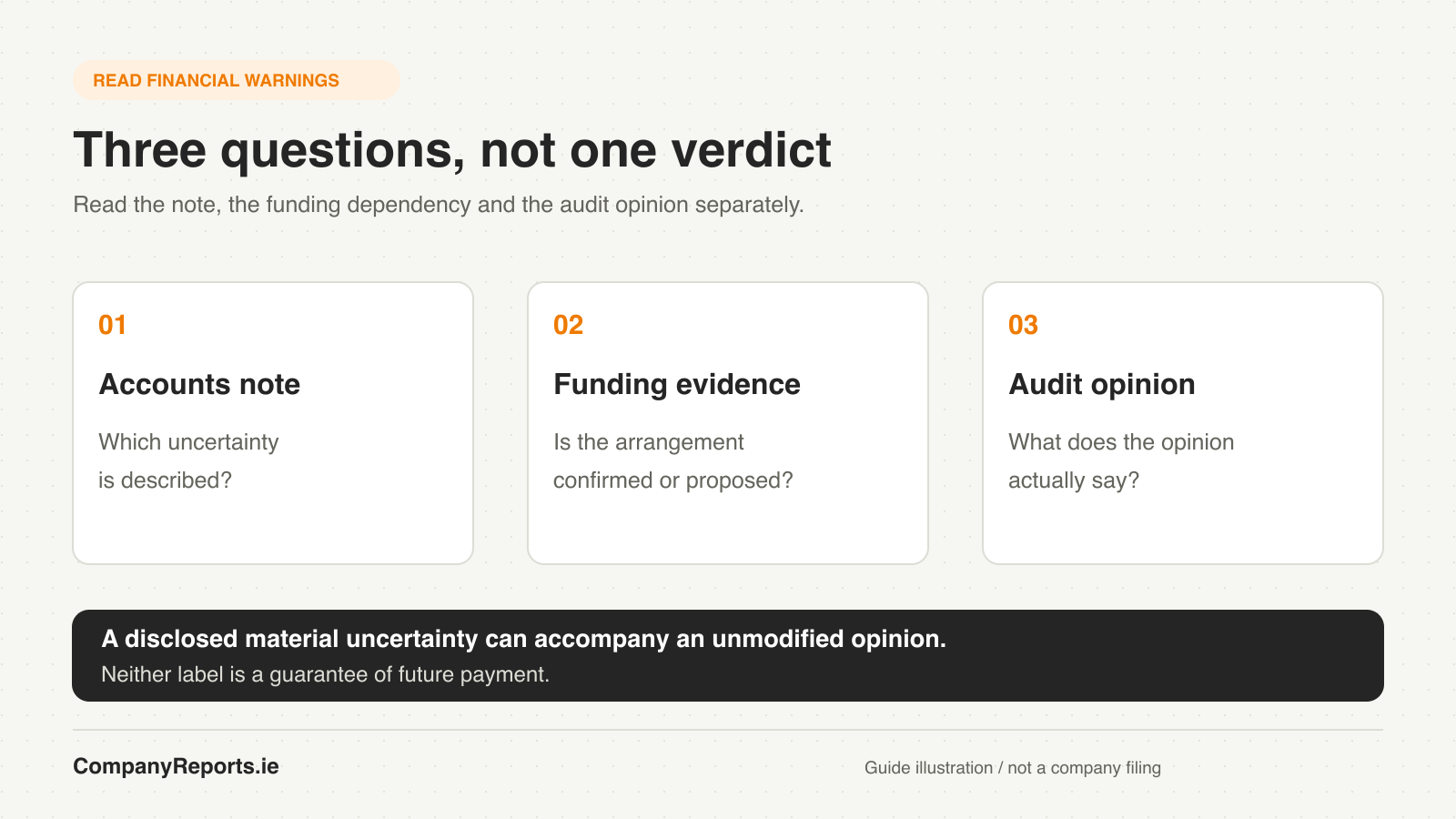
Management's assessment and the auditor's work have different roles. The Irish auditing standard addresses the auditor's responsibilities relating to going concern. It does not convert the auditor into the company's funder or remove uncertainty about future events. Start with the accounts note, then read any audit report alongside it.
Do not turn the concept into a single risk score. Your exposure may be a small completed purchase, a large advance for future work or a long-term credit arrangement. The same disclosed issue can have different relevance to each transaction. Understand what performance and payment you need from the company, and when you need them, before deciding which follow-up questions matter.
A material uncertainty is not automatically a modified audit opinion
Under ISA (Ireland) 570, an appropriately disclosed material uncertainty can be reported in a separate section while the auditor expresses an unmodified opinion. These statements are not contradictory: one addresses the uncertainty and the other addresses the financial statements under the relevant audit requirements. Read both before summarising the finding.
Do not reduce an unmodified opinion to 'the company is safe'. Equally, do not rename a material-uncertainty section a qualified opinion when that is not what the report says. Preserve the actual opinion wording and the referenced note. A short internal summary should make it possible for a colleague to locate the underlying evidence and read its full context.
IAASA's separate standard on modifications distinguishes qualified opinions, adverse opinions and disclaimers. The reason and extent of a modification matter; it may concern something other than going concern. When you encounter a modified opinion, investigate its stated basis instead of guessing from the label. Obtain professional help if its effect on your proposed transaction is unclear.
| What you read | What to inspect next | What not to conclude automatically |
|---|---|---|
| Unmodified opinion with material uncertainty | Referenced note and the uncertain condition | That there is no financial risk |
| Qualified or adverse opinion | The stated basis and its effect on the statements | That the reason is necessarily going concern |
| Disclaimer of opinion | The explanation and evidence limitations | That the auditor has provided a positive opinion |
| Audit-exempt accounts | Available notes and current supporting evidence | That silence is independent audit assurance |
Worked example: refinancing is the dependency, not the whole verdict
Imagine fictional accounts describing a EUR 300,000 borrowing facility that must be renewed. Management forecasts that the business can meet its obligations if the lender renews it, but renewal is unresolved when the accounts are approved. Your starting question is specific: what evidence now establishes the status and terms of that facility? The amount alone cannot answer it.
A later email saying discussions are positive is different from a signed renewal with conditions satisfied. A new facility can also have a lower limit, a shorter duration or restrictions relevant to the planned work. Ask for information proportionate to your exposure and have sensitive documents reviewed through an appropriate process if their details are necessary.
Suppose you plan to pay an advance for delivery several months later. The borrowing timetable and delivery timetable may overlap, making the issue relevant to that decision. A modest payment for goods already received has a different exposure. Neither example justifies predicting failure. The practical output is a dated question about a funding dependency and a decision matched to the evidence available.
How to read shareholder or parent-company support
Support language can cover very different arrangements. A forecast may assume further owner funding, while an accounts note may refer to an undertaking already given. As a reviewer, ask who is providing support, what form it takes and what period or obligations it covers. Record whether you inspected an actual document or only received a description.
Do not treat a recognisable parent's name as evidence that funding is unconditional or accessible to your contracting company. Group ownership, a loan agreement and a creditor guarantee answer different questions. If the commercial decision depends on enforceability, have a solicitor review the relevant commitment rather than inferring legal rights from an accounting note.
There is also a practical capacity question. An assurance from a supporting party does not, by itself, establish its resources or willingness to provide funds at the relevant time. Ask for the evidence that matters to the arrangement, without assuming that every company within a group has access to every other member's cash. Keep financial capacity and legal obligation as separate lines in your review.
Losses, negative net assets and cash pressure need different questions
A loss measures performance over a period. Negative net assets describe reported assets and liabilities at a date. Cash pressure involves the timing and amount of money available to meet obligations. These issues can occur together, but none should be used as a substitute for the others. Read the actual statement and notes before deciding what the number suggests.
For example, a fictional business can own valuable equipment while lacking cash for a near-term payment. Another can report negative equity while receiving documented long-term funding. Those simplified possibilities do not establish that either business is safe; they show why a label alone is insufficient. Investigate the obligations, timing and evidence rather than assigning an automatic outcome.
Forecasts add another layer. Ask what drives expected receipts, whether assumptions are supported and what happens if collections arrive later than planned. A sales forecast is not the same as cash received. For a substantial commitment, current financial information and specialist review may be needed to interpret the uncertainty in the context of your own exposure.
What if the public filing has no going concern warning?
First establish what document you are reading. An abbreviated public filing, full accounts and a separate company profile provide different levels of information. Some companies qualify for audit exemption; the official guidance explains eligibility. If no audit was performed, the absence of an auditor's warning is not an audit conclusion about the business.
Read the basis of preparation and relevant notes that are available, and avoid assuming that every reporting framework requires identical disclosures. FRC guidance on small-company going concern explains useful assessment concepts but expressly notes that Republic of Ireland disclosure requirements differ. Irish requirements and the framework actually used take precedence over a copied UK checklist.
An apparently reassuring document also has a date boundary. If a financing issue arose after approval, it may not be addressed in those statements. Ask what has happened since the accounts were authorised and retain any new evidence separately. The absence of a warning in the inspected document should be recorded accurately, without expanding it into an unlimited statement about today's position.
Turn the warning into a proportionate review, not an accusation
A useful review note identifies the company, period, source, exact issue and evidence still required. For example: 'The inspected accounts describe reliance on facility renewal. Current renewal terms have not been verified.' This is more precise than saying that the company is bankrupt, and it makes the next action clear without creating an unsupported public claim.
Match follow-up to the commitment. You might request clarification, obtain professional advice, reduce unsecured exposure or consider payment terms appropriate to the transaction. Those are commercial options, not conclusions dictated by one accounting phrase. Where the issue has been resolved, retain the evidence and date rather than relying on a verbal statement that everything is fine.
A company report helps organise identity and available records, but its stated contents and evidence dates matter. Before ordering, check whether the relevant accounts or filing are included and review the delivery arrangements. Use the report as part of a reasoned decision alongside current information; no historical filing or audit opinion should be presented as a guarantee of future performance.
- Which legal company and reporting period does the finding cover?
- What specific event or assumption creates the uncertainty?
- What evidence supports management's proposed response?
- What does the audit opinion actually say, if an audit exists?
- What has changed since approval, and how is it evidenced?
- How does the unresolved issue relate to your payment or delivery timeline?